
Writing a Municipal FAQ Without Accidentally Rewriting the Regulations
I figured that writing a Frequently Asked Questions page would be a relatively simple task—that is, until I started writing.
When I started working as a Wetlands Agent in a small town in Connecticut, there was already an unfinished FAQ draft. It had useful information in it and was clearly started for the right reasons. It explained some basic definitions, pointed toward the application process, and tried to answer the kinds of questions a resident or applicant might have.
But it also showed me why these documents can be hard to finish.
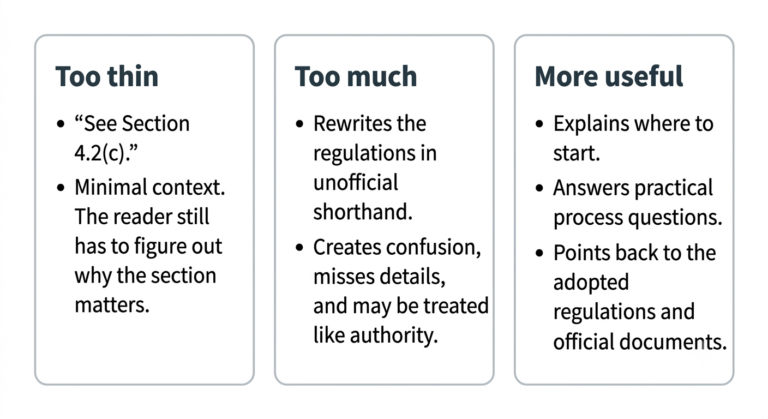
A FAQ can easily drift in one of two directions. It can become a substitute for the table of contents, where the answer to every question is basically “see Section 4.2(c).” That may be technically safe, but it does not help much. A resident looking for information about whether they can build a fence, take down trees, or put in a small shed is usually not looking for a reason to dig into the regulations. They might not know anything about wetlands regulations at all. They’re trying to figure out if they need a permit or not. And if they do need a permit, what do they need to do? Go to town hall? Go to a meeting? Fill out an application?
The other direction may be even worse. A FAQ can become a shorter, unofficial version of the regulations. It starts summarizing definitions, exceptions, review procedures, timelines, exemptions, application requirements, enforcement authority, and decision standards. Eventually it becomes a second set of regulations, except it’s less complete, not subject to proper updates and process, and easier to misunderstand.
That is not where I wanted to end up either.
My aviation maintenance background as a helicopter mechanic probably affects how I think about this. I have a strong aversion to “shortcut guides” and “cheat sheets” that start replacing the actual source documents. In aircraft maintenance, a note, checklist, or shop reference might help someone find the right procedure or remember a common issue, but it shouldn’t replace the manual, inspection criteria, or approved procedure.
Municipal land use is obviously a different world, but there are similarities in both fields. The adopted regulations, statutes, ordinances, and other official documents are the authority, similar to the FAA documents and approved maintenance manuals you’d use to maintain an aircraft. A FAQ shouldn’t become the shortcut document people rely on instead of those documents.
So, I asked myself–what is the FAQ actually for?
I don’t think the answer is “make the regulations easier to understand.” That sounds good, but it can lead straight into the trap of rewriting the regulations in friendlier language.
The better goal may be more modest and more useful:
A FAQ should help people understand where to start.
It should help residents, applicants, commissioners, and staff recognize when the regulations may matter, what practical steps come next, and where to find the official information. It should help people avoid obvious mistakes. It should answer the ordinary process questions that may not be spelled out clearly in the regulations at all.
So, maybe an FAQ should be a bridge, not a shortcut.
Most people don’t begin with a regulatory question. They begin with a normal project question.
Can I build a fence? Can I cut down trees? Can I put in a patio? Can I build a wall? How do I know if there are wetlands on my property? How far does my project need to be from a wetland or stream? Do I need to attend the commission meeting? Where is the application form? What should my site plan show? How long does this process take? Why can’t the commission approve my application the night it is received?
Those questions don’t always need a final yes or no answer. Often, they are really asking something more basic: “Am I in the kind of situation where I should contact staff, check a map, submit an application, attend a meeting, or read the regulations more carefully?”
That is where a FAQ can be useful.
So, I don’t think an FAQ should say, “Yes, you can build a fence,” or “No, you do not need a permit.” That answer may depend on location, nearby wetlands or watercourses, soil conditions, disturbance, installation methods, grading, clearing, access, and local regulations.
But a FAQ can say that fences in or near regulated areas may require review. It can explain that online maps are only a starting point. It can tell someone who to contact before they begin work. It can explain what information the town may need in order to answer the question properly.
That doesn’t replace the regulations. It helps someone understand why the regulations may matter.
This became clearer to me after working as a wetlands agent for a while and answering real questions. My FAQ wasn’t something I wrote perfectly at the beginning, and never touched again. It grew over time as I saw what people actually asked, what they misunderstood, what they left out of applications, and where they got stuck.
I’m thinking that’s probably how a lot of useful FAQs are written. They’re assembled from repeated questions, confusion, overlooked details, repeated emails answering the same questions, etc.
If applicants keep submitting site plans without distances to wetlands, the FAQ may need a clearer site plan section.
If people keep assuming an online wetlands map is official, the FAQ should explain that maps are only a guide.
If residents don’t understand why the commission can’t approve an application in the first meeting, the FAQ should explain the basic receipt and notice process.
If people keep asking whether they need to attend a meeting, the FAQ should answer that directly.
A good FAQ is grown from repeated conversations, questions, or confusion. It can also include practical town-specific information that does not really belong in the regulations. The town’s Wetlands Regulations may explain authority, procedures, definitions, review standards, and enforcement. They may not clearly explain where meetings are held, whether Zoom is available, how to use the online permitting system, where the forms are located, who to email, what time applications are due, how fees are paid, or what an applicant should bring to a meeting. It answers practical process questions you can’t find in Section 4.2(c).
I quickly learned that residents aren’t usually trying to avoid the rules. Of course, that happens too often–but a lot of times, they may just not know where the process begins, or that there is a process at all. A contractor may know how to build the wall but not know that the location puts it inside an upland review area—or that your town requires a permit while the neighboring town didn’t. A homeowner may know there is a wet area behind the house but may not know whether the town map is an accurate source. An applicant may submit a plan that makes sense to them or that worked in another town, but that doesn’t show the information this specific commission wants or needs to review the application.
The FAQ can help with those problems. It can also reduce dependence on informal town hall folklore. Someone remembers an old list. A retired staff member had a cheat sheet. A commissioner remembers how the previous chair handled a certain kind of application. A note in a file says one thing. The current regulations say another. Sometimes that informal knowledge is useful–a lot of it comes from real experience. But informal knowledge can become a problem when people start treating it like authority.
An FAQ can help by turning repeated practical knowledge into public guidance, while still pointing back to the official source documents. It shouldn’t preserve old cheat sheets, rumors, old habits, or the “Fred used to always do it this way” staff preferences.
That may be one of the most important parts of writing one. I shouldn’t ask, “What do we usually tell people?” I learned to ask, “Is what we usually tell people or give people still accurate?”
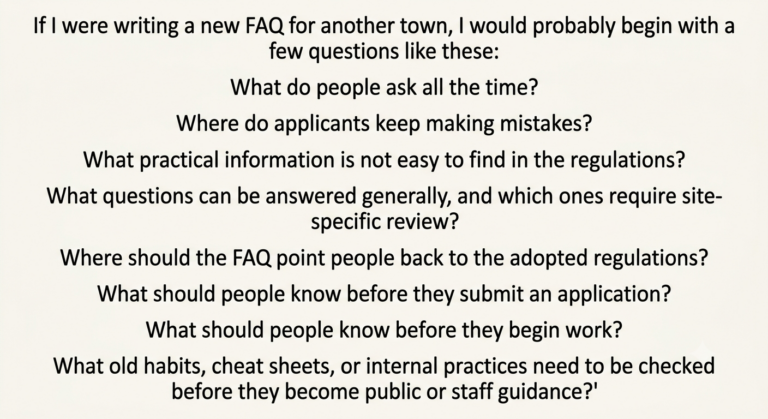
A FAQ doesn’t need to (and really shouldn’t) answer every possible question. In fact, trying to make it complete may be what prevents it from being finished. The first version can be short and to-the-point. It can answer the most common process questions, point people toward the official documents, and explain when they should contact staff.
Then it can be revised. Our FAQ wasn’t treated as a one-time writing project. It was revisited as people used it, and as we gained experience. If the same confusion keeps showing up in emails, phone calls, applications, or meetings, that is a clue. The FAQ may need another question, a clearer answer, or a better link.
For a small town, I don’t think the FAQ needs a design committee. It doesn’t need to become a polished guidebook full of diagrams and flow charts. It just needs to be useful.
It can help applicants submit better materials. It can save part-time staff from answering the same basic questions over and over. It can help new commissioners understand the process. It can make meetings run a little more smoothly. It can give the public a clearer path into a process that may otherwise feel mysterious or intimidating.
So, I tried to make sure that the regulations remained the authority, and the FAQ was the handrail.
It should help people through the official process without accidentally replacing the official process.
Here’s my example of a working and evolving FAQ, from when I worked as a Wetlands Agent: