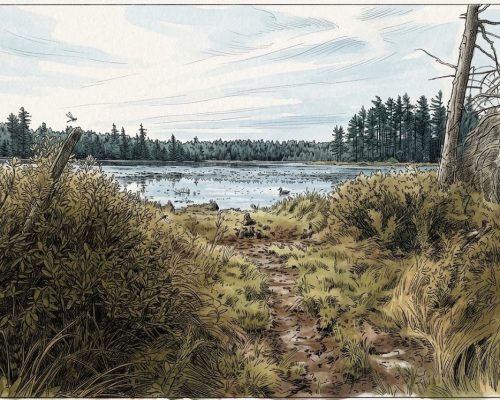
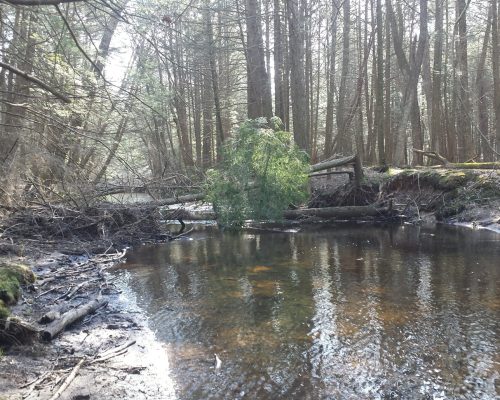
Give commissioners the opportunity to see the site before the meeting.
Wetlands commissioners are volunteers. They may understand the regulations well, but they have probably not visited the property in the application.
Without photographs, even a simple application can be difficult to visualize from a site plan or drawing.
A plan and description might show and discuss the wetland boundary, proposed work, limits of clearing, etc., but it doesn’t always provide the visuals that a commission might want in order to really understand the application.
- What does the slope actually look like?
- Where does the water appear to drain?
- Is the area wooded, lawn, gravel, or already disturbed?
- What lies between the proposed work and the wetland?
- What does the access point look like?
A few well-chosen photographs can answer those questions faster than several minutes of discussion.
My photo packets generally included wide views of the proposed work area, the wetland or watercourse, access points, drainage features, and anything else that seemed likely to matter during review. Sometimes I’d mark up the photos if there was some detail that needed to be pointed out.
The goal wasn’t to photograph everything–it was to give commissioners enough visual context to understand the application.
A short task can prevent a longer one.
One result was that the commission rarely needed site walks.
A site walk sounds simple, but administratively it isn’t free. Commissioners have to coordinate schedules. The meeting needs to be posted. Staff and the board clerk may have additional work. The applicant needs to provide access or needs to rearrange their schedule. Several people then spend time traveling to and walking the property.
Taking some photos of a site and assembling them into a PDF might take an hour but can prevent several hours of work later.
It also makes the regular meeting more efficient because commissioners arrive with a clearer understanding of the property. In a part-time Wetlands Agent role, approving a permit quickly in a limited number of meetings can save much-needed time for other important tasks.
The photo archive is always useful.
The photographs also become part of the permit record. If questions arise about compliance, vegetation removal, grading, drainage, or the original condition of the site, there is a dated visual record available instead of relying on memory. I referred to the photos quite often during the construction process. And, if there were any deviations or violations later, it sometimes provided helpful information. “The limit of clearing was flagged at that tree in this picture. Now the tree is gone, and it’s cleared 10 feet past, to that large rock, which is also in this picture.”
In that sense, the photo packet serves two purposes:
It helps the commission make the decision, and it documents what existed before the decision was carried out.
Good staff work reduces friction.
Municipal permitting often involves small opportunities to save much larger amounts of time later.
Taking and organizing site photographs was not complicated. It did not require specialized software or an elaborate procedure.
It just moved useful information to an earlier point in the process.