Redesigning Chainplate Knees on a Bristol 26 to Eliminate Movement and Leaks
When we first looked at Affinity, our Sailstar (Bristol) 26, the owner mentioned that the chainplates were leaking.
At the time, that didn’t seem like a big deal. I figured I’d deal with it when the time came. After all, it was a 50-year-old boat. It’s going to have some issues.
We had already looked at several different boats, it was getting close to spring, and I was expecting to take on some level of project no matter what we bought. This boat came with good sails, a solid motor, and a lot of extras, so it felt like some sealing and a little fiberglass work was a fair trade.
The chainplates were hidden behind fiberglass covers, with old outdoor carpet laid over a mustard-colored felt liner that had been glued to the hull and shelves below.
After buying the boat and starting to pull all of that out, it became clear that “the chainplates leak a little” was only the beginning.
The knees were separating, the surrounding structure had started to rot, the shelf below was wet and soft, and the upper shroud chainplate on the main bulkhead had shifted upward slightly. The whole thing looked like it had been that way for a while.
The outdoor carpeting had done a nice job of isolating everything on the shelves from the soft wood underneath, which let the damage and rot keep progressing without causing too much of an inconvenience. And maybe I was a little too polite when looking at the boat—I didn’t really want to move all of the previous owner’s stuff and start unscrewing covers and ripping felt off the hull with him standing behind me.
On the other hand, it was a cheap old boat, and I may have bought it anyway. I like to keep old things going.
This is a write-up of how I repaired those areas, and why I changed the design instead of just rebuilding what was there.
What was going on
Once everything was exposed, the pattern was pretty consistent.
All of the chainplate knees shared the same basic issues:
They were bonded primarily to the hull
There was a gap between the knee and the deck
The load from the rigging pulled the hull inward, especially at the bottom of the knee
Over time, the knees began to separate and delaminate
As that movement developed, the chainplates were able to shift slightly. That was enough to open up leaks at the deck, which led to water getting into the plywood knee and the deck around the chainplate.
Movement led to leaks. Leaks led to rot. Rot weakened the structure enough to allow more movement.
On the dinette side, the aft lower shroud’s chainplate had been leaking long enough to completely rot the shelf beneath it and turn it into a nice habitat for algae and some kind of little tan bugs.
On the galley side, the counter was saved mostly because it wasn’t attached to the hull, which allowed the leaks to run down into the bilge instead.
The bulkhead failure was more straightforward. Water from poor sealing and an exposed deck core rotted the plywood. Eventually, the upper shroud chainplate started to move upward as it tried to exit the cabin and spend more time on deck. I don’t blame it much—the cabin had that “musty old boat” feel from all the damp wood and old carpet.
Once everything was opened up, it was hard to ignore how little of the structure holding the mast up was actually still doing its job.
Why I changed the design
At that point, the question wasn’t just how to rebuild it, but whether it made sense to rebuild it the same way.
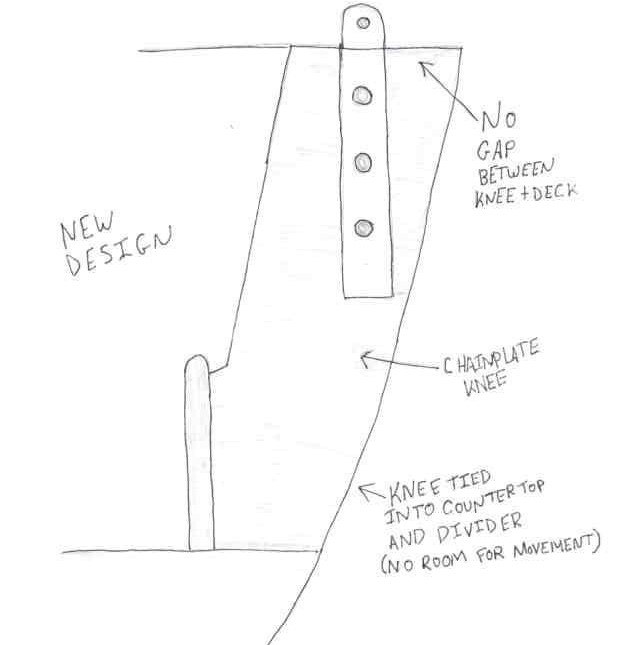
The main issue in this boat was related to how the load was being handled. The original knees were relatively small and only strongly bonded on one side (the hull). The deck wasn’t really part of the structure, and interior pieces nearby like the shelf or the galley countertop weren’t contributing structurally.
Rather than replacing parts one-for-one, I wanted to change how the load moved through the boat.
The general direction I took was:
Enlarge the knees and tie them into more than just the hull
Increase the bonding area
Reduce the opportunity for movement
Keep water away from any exposed wood
That led to a design where the knees are tied into the hull, the underside of the deck, and nearby interior structure like the shelf and bulkhead.
The goal wasn’t to make it complicated. I just wanted to take advantage of the other structures in the boat and make it much harder for anything to flex or shift over time.
Dinette side: removing the old structure
The dinette side was in the worst shape, so that’s where I started.
After removing the shelf and chainplate knee, I was left with a fairly clean surface. Conveniently, the rotted and delaminated original structure came out easier than expected, which cut down on the amount of grinding prep needed.
With everything exposed, it was easier to see how the original pieces had been working independently rather than as a single structure.
Rebuilding the shelf and chainplate knee
Templates and Layout
I started by making templates for both the shelf and the new knee.
The new knee was laid out to:
Run from the hull up to the underside of the deck
Tie directly into the shelf
Cover a larger area than the original
That turned the shelf from something that just filled space into part of the structure supporting the chainplate.
Installation
The process was fairly straightforward, just a bit time-consuming:
Replacement pieces were cut from marine plywood
Pieces were initially bonded together with thickened epoxy
All mating surfaces were coated before installation
The structure was set in place and supported while curing
Fillets were added at all joints
Everything was tabbed in with biaxial fiberglass
Once the fiberglass work was done, I went back and faired the surface to get it ready for finishing.
At this point, the shelf and knee were no longer separate pieces. They acted more like one continuous structure tied into multiple surfaces.
Chainplates and deck work
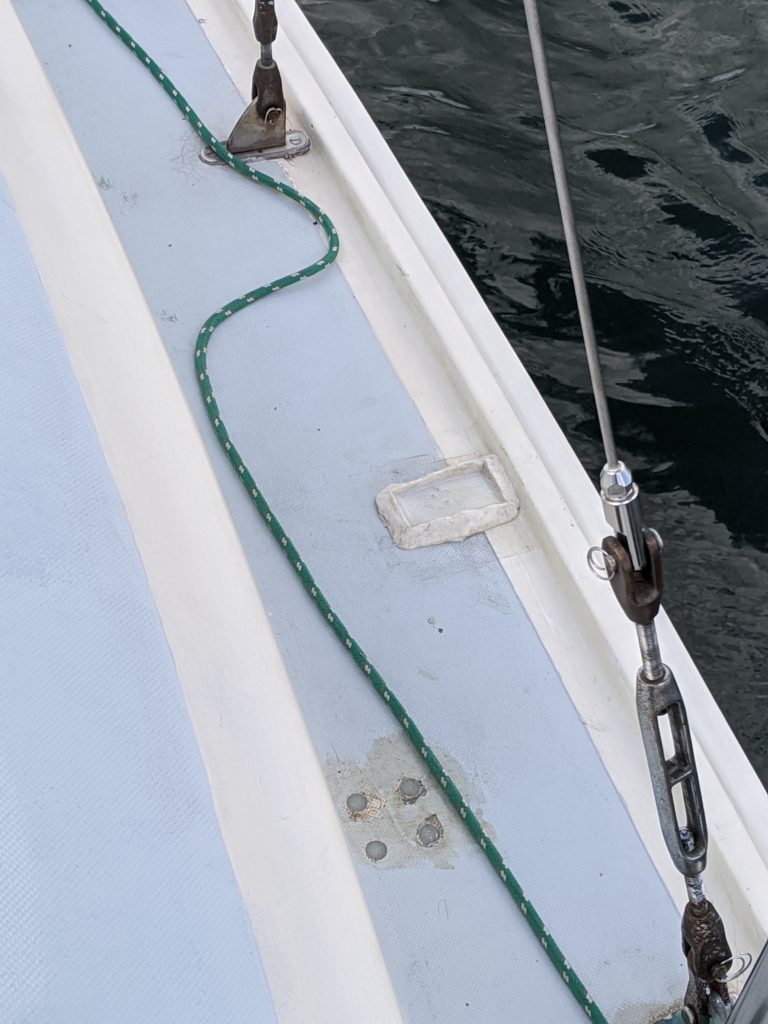
The original chainplates showed some pitting, especially where they passed through the deck, so I made new ones from 316 stainless flat bar.
I used the old chainplates as a template and shaped the new ones with a sawzall and grinder, taking care not to overheat the metal while cutting and grinding. After that, I polished them by wet sanding and buffing them to remove any fine scratches.
The top section of the old chainplates were cut off so I could reuse the lower parts as backing plates.
Sealing the structure
Water intrusion seemed to be a big part of how the original structure failed, so I tried to treat every joint and hole as something that would eventually leak.
For the chainplate mounting holes:
Holes were drilled oversized
Filled with thickened epoxy
Redrilled to the correct size
At the deck:
Any exposed balsa core was removed
The void was filled with thickened epoxy
A raised collar of thickened epoxy was built around the chainplate opening using modeling clay as a form. This raised section helps keep water from sitting around the opening and finding its way below.
Bulkhead repair - assessing the area
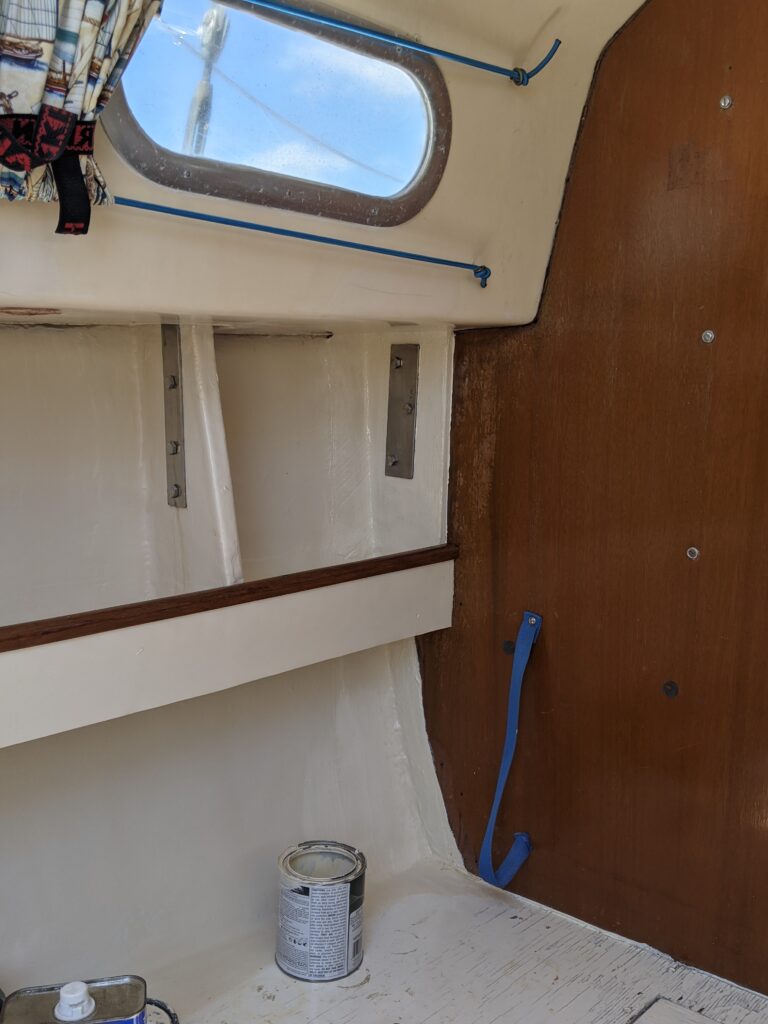
The main bulkhead had localized rot around the chainplate for the upper shroud, causing it to start to pull upwards. The rest of the bulkhead was still in good shape, so removing the entire thing didn’t seem necessary. I just had to come up with a way to sandwich the repair and not create any weak joints between the original bulkhead and the repaired portion.
Repair Method
The repair was done by removing only the damaged section and tying the new material into the existing structure.
The rotted section was cut out
Surrounding surfaces were ground clean
A replacement piece of marine plywood was fitted
A second, larger piece was added over it to overlap the joint
Everything was bonded together with thickened epoxy
The area was tabbed into the surrounding structure with biaxial cloth
After that, the surface was faired so the new chainplate and backing plate (made from the old chainplate) would sit flat
The overlapping layer of plywood helps to spread the load out beyond the repair area and create more surface area and angles to help tie it back into the original material.
This repair was also tied into the previously reinforced shelf in the dinette area, which helped stiffen things further.
Galley side repairs
The galley side had two chainplate knees:
One for the upper shroud
One for the aft lower shroud
The forward lower shroud knee was still in decent condition (probably because it didn’t have a large gap between the deck and the knee) and was left alone for a future project.
Since the boat was on a mooring with the mast up, the knees were replaced one at a time to avoid removing too much support from the rig at once.
Process
The approach was similar to the dinette side, with a few adjustments based on what was already there:
Old knees were removed with the oscillating cutter and angle grinder
Surfaces were ground clean
Templates were made. I used an old outdoor sign (like those political signs that are everywhere in the fall), and it is sturdier than cardboard, water resistant, and easy to cut
A shaped plywood layer was added to the galley countertop to close the gap between the counter and the hull so it could be tied together
New knees were built tying into the hull, deck, and counter structure. Everything in the area was now basically one solid structure.
All components were bonded with thickened epoxy and tabbed in with biaxial cloth.
Finishing
Once the structural work was complete:
Surfaces were faired
A TotalBoat TotalProtect two-part epoxy barrier coat was applied
The area was painted with Sherwin Williams urethane enamel to match the cabin
The cabin ended up brighter, drier, and noticeably more solid than before.
Final thoughts, and how I think about this type of repair
This ended up being one of the larger projects on the boat, but also one of the more important ones.
The failure didn’t come from one big event, or even from a lack of sealant maintenance. It came from poor original construction leading to small amounts of movement over time. The original setup allowed movement, and that movement led to leaks, rot, and delamination.
Looking at it that way, the goal wasn’t just to replace damaged parts.
It was to:
reduce movement,
take advantage of the structure around the chainplates as much as possible, and
keep water away from any wood that could absorb it.
By tying the structure together more effectively and sealing off potential water entry points, the repaired areas are dry and feel much more stable.