Repairing a Rotten Deck Core Without Cutting the Deck Open

Affinity, our Bristol 26, had slowly accumulated hardware and accessories over the years.


Two VHFs.

Two autopilots.

Three antennas.

Coaxial pass-through fittings with no cables in them.

Powerboat-style dinghy davits.

Extra cleats.

Old depth finders.

Unused plumbing.

Unused wiring.

Holding tanks and plumbing taking up both V-berth lockers.


At some point, you start wondering how there’s still enough room left on the boat to actually sail it.


Like many older boats, nothing had ever really been removed. New systems were layered on top of old ones until the stern looked less like a coherent design and more like a running record of past decades.


The old traveler that was installed on the boat was cracked, corroded, worn out, and didn’t really fit in the spot it had called home for many years. Working around the coaming boards and motor well meant pulling the control lines at awkward angles—and when I pulled at that awkward angle and ripped a cam cleat partially out of the deck last year, I knew it was time for a redesign.


I decided to switch over to a twin mainsheet setup, which was substantially cheaper, especially since I already owned an extra mainsheet and some pad eyes. The twin mainsheet is also similar to what was originally on the boat, and fits the area around the motor well much better, which was probably why a similar setup was there in the first place.


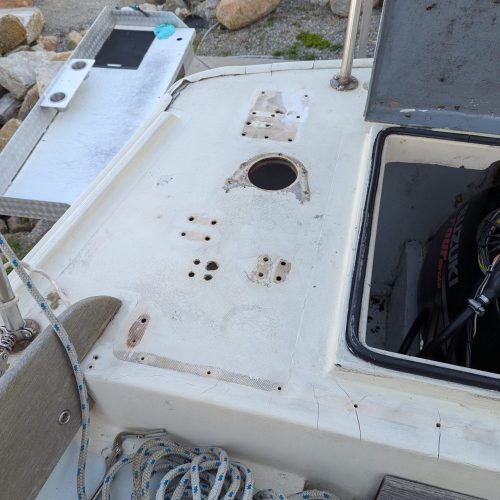
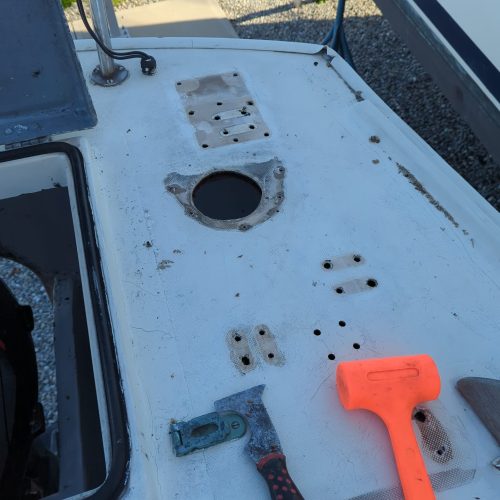
As with most of the other modifications on the boat, I pulled a few fittings and discovered wet, deteriorated deck core around the old holes.

PXL_20251029_202020312

The Two Internet Answers


In the world of the internet, that discovery usually triggers one of two responses.


The first: 


“The only correct repair is to cut the deck open and fully recore it.”


The second:


“Inject foam or filler into it and hope for the best.”


I ended up somewhere in the middle.


Understanding the Structure Before Choosing the Repair


Before deciding how to fix it, I wanted to understand and learn about what I was actually looking at.


There are plenty of situations where a full recore is the right decision. If the damage is widespread, the skins are compromised, or the structure is heavily loaded, cutting the deck open may be the only proper repair.


In this case, the top and bottom fiberglass skins were still intact, the damage was localized (divided up by the motor well), and I already had unusually good access through the motor well vents and the sheer number of existing holes from previous hardware installations.


After removing a significant amount of wet core material with scribes, scrapers, and screwdrivers, I started thinking less in terms of “replacing the wood core” and more in terms of rebuilding a sealed composite structure inside the existing deck skins.


I’ve worked around composites in several different environments over the years, including marine work and specialized repairs on UH-60 tail rotor paddles. Obviously, a sailboat deck is not a helicopter rotor system, but the underlying principles transfer surprisingly well:


  • load paths matter
  • bonding matters
  • moisture control matters
  • and “good enough” depends heavily on understanding the actual structure involved


The internet often treats repairs as either perfectly textbook or completely wrong. In practice, reality is usually more nuanced than that.

PXL_20260504_224958150
image-1777323758778

The Repair Approach


Cutting the deck apart felt more invasive than necessary given the access I already had. At the same time, spraying foam or dumping filler into the voids wasn’t a good option either, since this area would be supporting stern cleats and pad eyes for a mainsheet.


The loads on a mainsheet can be significant, especially since a pad eye concentrates load—unlike the old traveler, which distributed it across the track.


Instead of injecting foam or simply pouring epoxy into hidden voids, I used a combination of:


  • tedious removal of deteriorated core material
  • allowing the area to dry thoroughly
  • penetrating epoxy to stabilize and seal remaining core edges
  • epoxy-saturated chopped strand fiberglass to replace the lost core material
  • thickened epoxy to seal edges and fill old holes
 

The goal wasn’t to recreate the original wood core exactly, but to create a dense, sealed composite section that would resist future moisture intrusion and provide solid support under the hardware.


To make the fill material, I bought fiberglass mat, cut and shredded it into small pieces, and mixed it into epoxy. The resulting mixture was packed into the cavity.


In areas that were only accessible through small holes, I would:


  • inject epoxy
  • stuff fiberglass into the hole
  • inject more epoxy
  • repeat
 

until the cavity was fully packed and saturated.


Afterward, all fastener locations were overdrilled, filled with thickened epoxy, and then redrilled.  This step eliminates the need for sealant to protect the core, leaving sealant to do what it does best: keep water from entering the joint and protect the cleats/pad eyes, etc.


In the end, the repair transformed the area from “soggy wood core” into a solid, sealed composite structure.

It used a fair amount of material, but the result feels very solid.


Time will tell how it holds up, but so far the area is dry and solid.

PXL_20260504_224930079
PXL_20260509_191630021
PXL_20260507_185024903
PXL_20260511_202721481

The Rot Wasn’t the Real Problem


The core damage was really just a symptom.


The underlying issue was the number of untreated holes in the deck.


Every fitting on a boat represents:


  • another way for water to reach the core
  • another sealant joint
  • another future leak opportunity
  • another maintenance obligation

Over time, boats accumulate systems the way old workshops accumulate coffee cans full of mystery fasteners.

Each addition made sense at the time. But eventually, you have to step back and ask:

“What actually still belongs here?”


Simplifying Instead of Rebuilding


As part of this repair, I chose not to reinstall most of the removed hardware.  The old dinghy davit locations became the new stern cleat locations using a simpler layout with larger Herreshoff cleats. The smaller, unnecessary fittings were left off entirely.


The result is a deck that is:


  • cleaner
  • structurally stronger
  • and far less prone to future water intrusion


A Better Outcome Than Simply “Restoring”


One thing I appreciate about old boats, compared to aviation, is that they rarely require perfection—just a little thought and understanding.  Often, the best repair is not restoring a system exactly as it originally existed, but simplifying it into something more durable, more maintainable, and more intentional than what evolved over decades.


In this case, the soggy deck core became an opportunity to remove complexity instead of preserve it.  And hopefully, the boat is better for it.

PXL_20260511_210952458