Replacing Seacocks and Making Backing Plates on a Bristol 26 Sailboat
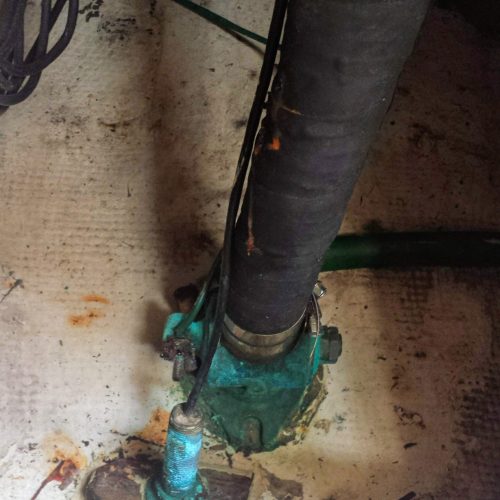
The first job to do on the 1970 Bristol 26 was to replace the original seacocks. None of the valves worked anymore–and having working seacocks is a necessity. The original ones were inviting disaster—when I removed the hoses, one of them tore open just from me pulling it off by hand. It would be a little disconcerting to have a rotted out old hose as the only thing keeping the ocean out the boat, but you see stuff like this on a lot of old sailboats.
The original seacock for the sink drain--it was corroded open, and the handle was broken off.
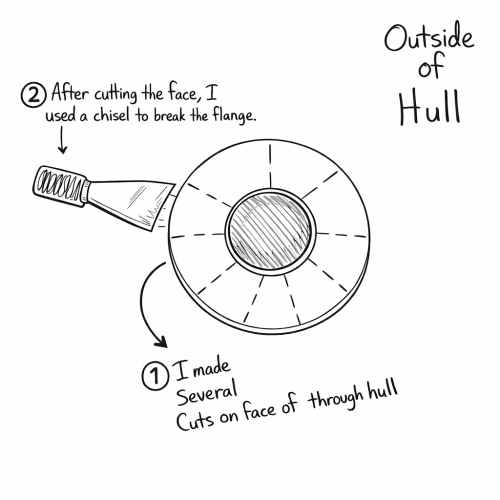
The old valves weren’t through-bolted to the hull, so removal wasn’t very difficult. I used a cordless Ryobi multitool with a carbide blade to cut the flange on the outside of the hull. I cut the flange into sections, then chiseled each piece off, and pressed the freed through hull into the boat.
Here's a drawing of the process I used to remove the old seacocks.
Back in the shop, I laid up some thick fiberglass backing pads, then epoxied them in place inside the hull. Next, I used some 5200 sealant on the inside of the flange, and tightened the through hull with a tool I made out of a piece of metal that I ground down to fit the keyway in the seacock.
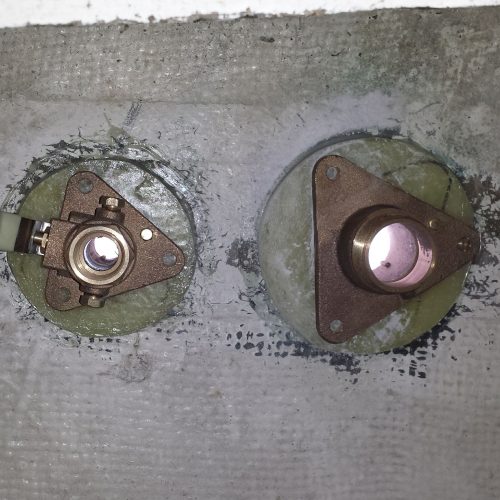
These are the seacocks for the toilet- I removed the original head and holding tank, so I just capped these for now, in case they're needed in the future.
I needed to enlarge the hole for the sink drain, so I used a special purpose hole saw bit. The hole saw for the existing hole attaches on the inside of the bit, and acts as a guide for the larger hole saw.
Here's the finished seacock for the sink drain.
I didn’t want to drill more holes to through-bolt the seacock, so I drilled and countersunk the backing plate, put some epoxy into the holes, waxed the threads on some bolts (to ease in later removal) and pressed them into the epoxy. I have done this on a few boats now, and it seems to hold up fine.
![]TUXYW^aXQQNLM](https://www.overthereef.com/wp-content/uploads/elementor/thumbs/20190515_174920-1-rkb6e7392kslgfq1n28rl0682eowrfuowdmqsftgnc.jpg "]TUXYW^aXQQNLM")